
Five Common Mistakes People Make About the Moon
The Moon is the easiest object in the night sky to find and one of the easiest to misunderstand. Most of us were shown a diagram at school, remembered part of it, and have carried a slightly wrong version around ever since. The five mistakes below come up again and again, and each one is straightforward to correct once you know what to look for.
Mistake one: Earth's shadow causes the phases
The Moon does not go dark because we are standing in the way of the light. Half of the Moon is lit by the Sun at every moment of every day. What changes is how much of that lit half faces us as the Moon travels around Earth.
At new moon, the Moon sits between Earth and the Sun, so its bright side points away from us. A week later we see half of it, then nearly all of it at full moon, then less and less. The whole cycle takes about twenty-nine and a half days, which is why a full moon lands on a slightly different date each month and why you can sometimes catch it rising before sunset.
Earth's shadow only reaches the Moon during a lunar eclipse, and eclipses are rare. They also look nothing like a normal phase. Instead of a clean crescent appearing on schedule, you watch a dark bite creep across a full moon over an hour or two. If the Moon is a crescent, Earth's shadow is not involved.
Mistake two: the far side of the Moon is its dark side
The face we never see is not permanently unlit. The Moon is tidally locked: it turns on its own axis in roughly the same time it takes to orbit Earth, about twenty-seven days, so the same hemisphere always points our way. Both sides get sunlight. When we have a full moon, the far side is having its own night; when we have a new moon, the far side is in broad daylight.
Astronomers say far side rather than dark side for exactly that reason. And the lock is not a coincidence. Over a very long stretch of time, Earth's gravity has slowed the Moon's spin until its rotation and its orbit matched. The same has happened to many moons elsewhere in the solar system.
Mistake three: the Moon sits at a fixed distance
You will often see the figure of about 384,000 kilometres quoted, and the word average is doing real work there. The Moon's orbit is an ellipse, so its distance varies by tens of thousands of kilometres — closer to 363,000 km at its nearest point and about 405,000 km at its farthest.
That is why you hear about supermoons. A full moon near its closest approach looks roughly 14 per cent wider than one at its farthest, and it can be genuinely impressive. It also means the Moon's apparent size shifts gently from month to month, whether or not anyone gives it a headline.
- The low Moon looks enormous. That is the horizon illusion, a trick of perception. Your eyes compare it with rooftops, trees and chimneys; high in an empty sky there is nothing to compare it with.
- Test it with your hand. Hold up a little fingernail at arm's length and cover the Moon when it is low. Do the same an hour later once it has climbed. The nail covers about the same amount both times.
- Try photographs instead of memory. The same lens on the same settings gives the same sized disc whenever you shoot, whatever your eyes insist.
Mistake four: the Moon alone rules the tides
The Moon is the main driver. Its gravity raises a bulge of water on the side of Earth facing it, with a matching bulge on the opposite side as Earth is pulled slightly away from the sea. As Earth rotates through those bulges, most coastlines get two high tides roughly every 24 hours and 50 minutes. In a few places, the shape of the coast interferes and one high tide a day dominates instead.
But the Sun pulls as well, with a bit less than half the tidal strength of the Moon. When the two line up, at new moon and full moon, you get the biggest tides of the month. These are called spring tides, nothing to do with the season. When the Sun and Moon pull at right angles, at the first and last quarters, you get smaller neap tides.
Local geography and weather matter enormously too. The funnelling shape of a river mouth or a narrow channel can amplify a tide far beyond what the open ocean sees, and an onshore gale can push more water into a harbour than the difference between a spring and a neap tide.
Mistake five: a full moon makes everyone behave strangely
It is one of the oldest beliefs going, and a tempting one: crime, births, madness and sleepless nights all blamed on the bright nights around full moon. Studies that have hunted for a link have generally failed to find a consistent one, and the small effects that occasionally appear tend not to show up again when someone repeats the work.
That does not mean the Moon has no effect on your night. A full moon is bright enough to keep you awake if your curtains are thin, which probably explains more than any mysterious force. If you are curious about your own sleep, note the moon phase next to how you slept for a couple of months and see whether a pattern survives.
How to check the Moon for yourself
None of this needs equipment. A pair of binoculars and a bit of patience will do more than any app.
- Watch the line between light and dark. That edge is called the terminator, and along it the Sun is rising or setting on the lunar surface. Craters cast long shadows there, so the Moon looks more three-dimensional through binoculars than it does at full moon.
- Look for the Moon in daylight. You can often see it mid-morning or mid-afternoon. Spotting a pale half moon in a blue sky is the quickest proof that phases have nothing to do with darkness.
- Run the lamp-and-ball demonstration. In a dim room, hold a ball at arm's length and walk slowly around a lamp. Watch the lit portion of the ball shrink to a crescent and grow to full as you move. That is the whole phase cycle, in your hand.
- Compare tide tables. Find the tide times for your nearest port and look at a week around full moon, then a week around the quarter moons. The difference in range is usually obvious.
- Keep a simple chart. Sketch the Moon's shape on a calendar for one month. Thirty days of your own notes will teach you more than any diagram.
Once you have watched a full cycle from new moon to new moon, the myths above tend to fall away on their own. The Moon is far more interesting when you know what you are actually looking at.
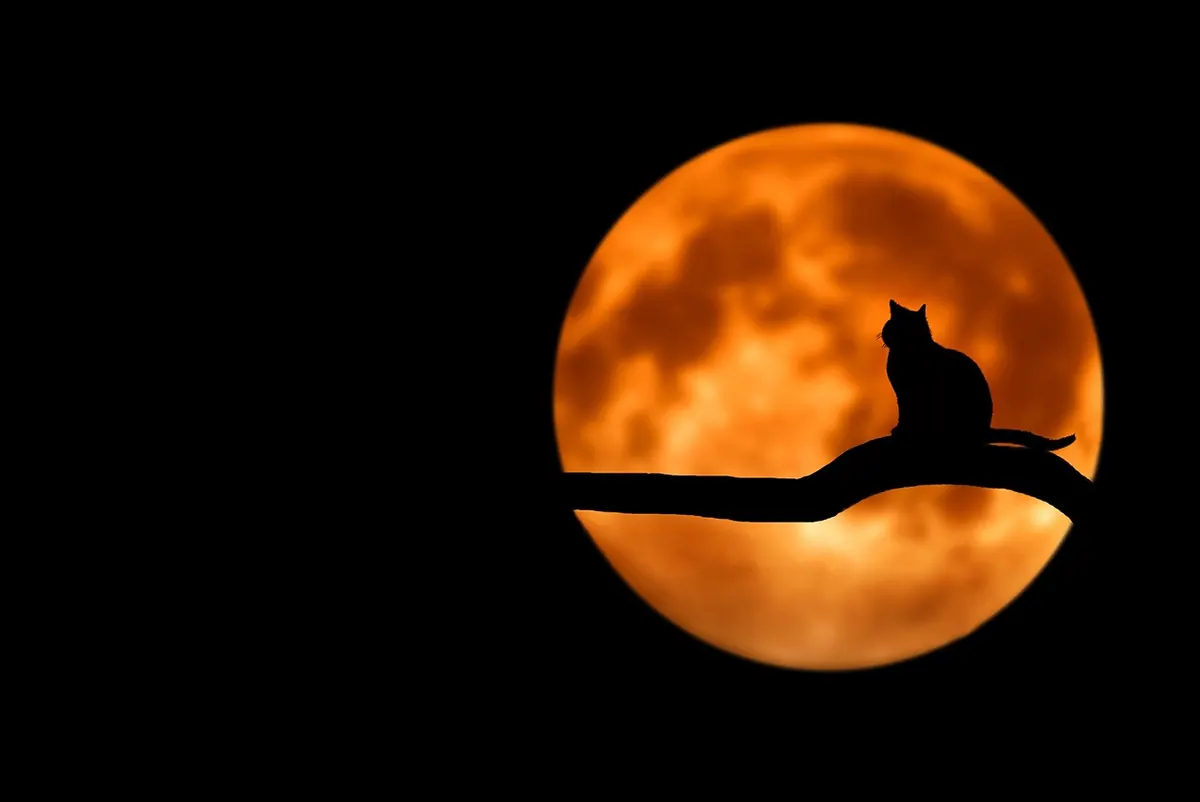
Photo: Bessi / Pixabay